Showing posts with label lensman. Show all posts

Monday, April 18, 2022

My Life As A Writer: No, Eckhart, It's Because The Writers Suck

I'm taking this Pop Cult video as a jumping off point for a very common Space Opera problem: Bad Scaling.

That's a lot of cope. It's this simple: most writers have no clue what they're talking about. Uncle George has real limits that his chosen medium imposes, reinforced further by deadlines and financial constraints, but novelists and comic authors do not.

The sort of "major fleet action" that constitutes climatic battles marking the apex of a narrative arc in Uncle George's Space Opera (and the Mouse Wars knock-offs) are skirmishes in E.E. Smith's Lensman series and Yoshiki Tanaka's Legend of the Galactic Heroes. By the time those series reach narrative peaks, we're looking at hundreds of thousands or millions of capital ships per side with tens or hundreds of millions of combatants.

That is the sort of scale that truly epic Space Opera requires, and very few authors even comprehend what that is- nevermind how it would work or what two competing forces of that size and scale would do to defeat the other. Uncle George, and others in his sphere like Battlestar Galactica (both versions), didn't even try- and George, at most, implied it was possible.

The problem is that these writers fail to see that combat--at any scale, from man-to-man all the way up to universal scale--is nothing more (in narrative terms) than a stage to develop character and advance plot. The difference is that you do so by action--what someone does and how they do it--instead of by dialog. In film or comic terms, this leads to the ideal of a scene where the entire narrative unfolds without a single word or grunt uttered; all character development, and plot advancement, occur silently.

This, by the way, is hardly impossible. Ryan vs. Dorkman did this on a lark 16 years ago, and you'll see others with experience in stunt work or fight choreography do short films like that on the regular- both to stay in practice and to add to their film reels for big boy work.

And no, Hellmouth and OldPub writers as a class don't do Git Gud so they won't put in the work required to make their Space Opera better. They rely on nepotism and corruption to get paid, just like their fellow travelers elsewhere in the Death Cult, so you're going to have to go old-school, go Indie, or go East to get your eyeballs on stuff that doesn't suck.

Sunday, November 1, 2020

My Life In Fandom: Space Opera Can't Have Too Many Super-Weapons

Things got you wound up? Need something stupid to laugh at? Eckhart's Ladder--the most fanboyish of fan channel for Space Wizard Fun Time--has you covered.

Of the complaints made here, only one doesn't play: "there are too many superweapons".

We're talking a galaxy-sized setting. Space Is Big. There are too few superweapons, not too many, and the galaxy is stupidly under-populated even for the agranian worlds. A galaxy-spanning civilization, even one riven by competing states, will nontheless be measured in the hundreds of trillions in population and should be expected to field Death Stars as if they were Star Destroyers (and Star Destroyers as if they were actual destroyers and not battleship/carrier hybrids).

This sort of thing is what E.E. Smith--the father of Space Opera--got right with the Lensmen series, and man did the super-weapons in that series get crazy: trans-galactic railguns using dead planets as ammo, weaponizing entire stars as super-lasers, planet-sized webs that disintegrated what they touched, and so on. Compared to what he wrote, the super-weapons of both Western and Eastern Space Opera in comics, film, and television is often pathetic.

(Note: You have to start thinking in terms of Getter Emperor, Mazinger Zero, Ideon, the Third Impact, fully-powered Zeorymer, Super Tengen Toppa Gurren Lagann/Super Anti-Spiral, etc. to get on Smith's level. Iserlohn and Geiserberg from Legend of the Galactic Heroes are entry-level efforts by any galaxy-spanning civilization worth a damn.)

And that's before we start talking biological weapons. That's when things really get nasty.

Wednesday, October 31, 2018

My Life In Fandom: The Mouse Murdered Star Wars

If you still think Mouse Wars can be saved, allow me to demotivate you.

Here's your horror story, folks. Mouse Wars has successfully murdered something you loved, skinned and gutted it, and now goes about pretending to be it while wearing its skin as a grotesque costume.

Ever since Uncle George sold out to the Mouse, we've had some trepidation. Despite its flaws, The Force Awakens wasn't that bad; it was as safe a film as it got, being a remake of the original, but it was on the margins that the real nature of what went down first appeared and that corruptions exploded when The Last Jedi shat up the screen. It's only gotten worse since with all the media bullshit and SJW virtue-signalling.

The prequels were flawed, but earnestly so; the originals remain fantastic (but not perfect). We can just disavow Mouse Wars and be fine, so that's what I do; in the meantime, there's plenty of #StarWarsNotStarWars out there that focuses on something you love about Uncle George's love-letter to the pulps. Loved the grunt-focused episodes in Clone Wars? Galaxy's Edge is there for you. Fleet action and court intrigues? Legend of the Galactic Heroes and Tyrania await. The last best hope to save the galaxy? Yamato, Babylon 5, et. al.

And if you really want it all done better, go to the source: the Lensman books by E.E. "Doc" Smith. Better Jedi than the Jedi. Better superweapons than anything George or the Mouse allowed. Better action, better romance, powered armor (the origin for it and mecha generally), and so much more. Skip the anime and manga adaptations; they're trash.

And then there's my own upcoming #StarKnight series as well as Brian Niemeier's Combat Frame Xseed. Despair not over the loss of Star Wars; what it came from endures, and what came of it already surpasses it. Go forth and enjoy the diaspora born from Uncle George's accidental masterpiece.

Tuesday, May 16, 2017

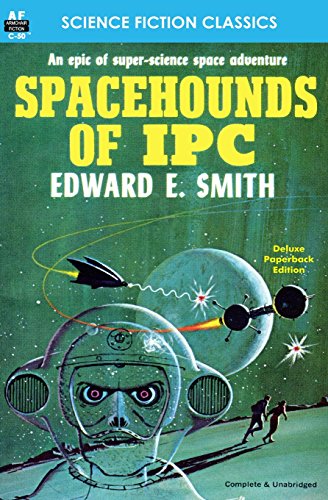
Space Opera Week: Spacehounds of IPC

E.E. "Doc" Smith is famous for the Lensman series, but he's got plenty of other books that one rightly considers Space Opera. Most will point you to his Skylark series, but today I'm pointing you to a 1931 serialized story turned into a 1947 stand-alone novel: Spacehounds of IPC.

This is Space Opera that isn't interstellar, which doesn't change the quality at all; as with the Gundam franchise, you get all of the fantastic elements without needing to go outside the solar system. (Which is further than most Gundam shows, which don't even leave the Lunar Sphere.) The characters aren't larger-than-life like a Lensman is, but they're clearly heroic and the stakes are plenty big. The events have their reversals and diversions before finally coming to a satisfying conclusion.

The big takeaway from this book is this: Space Opera doesn't have to be an epic against a Dark Lord to be proper Space Opera. How big a story's adventure is depends on the characters concerned. Lensmen have to operate on galactic scales because they're superheroic in scale, scope, and power whereas the characters of this story are what TV Tropes calls "Badass Normal": otherwise ordinary people possessed of heroic resolve and determination. You don't need to blow up the Death Star to have a valid Space Opera; indeed, that's getting lazy about it.

The second takeaway is this: you can have a thrilling Space Opera where the plot does revolve around technical issues directly relevant to the plot, using it in place of a quest-style McGuffin to drive the plot forward. Much of this story's driving force comes from dealing with the initial incident that strands the characters in their dangerous environment, fixing what can get fixed and assembling components to solve another plot-relevant problem. How? By using each part of the problem-solving process to frame the next part of the adventure and introduce the next revelation in the narrative. You don't need to use The One Plot.

The third takeaway is this: you need not fear the technologies said to short-circuit a plot. The characters, being in a Lost In Space scenario, do the smart thing and put together a device that can allow them to call for help. Then they do so, and pass on all they know of the villains to the rescue team. No Idiot Balls Required!

Learn from the masters, because--contrary to the Pink Slime Cult's dogma of "Newer Is Better"--Culture is NOT Technology- "Progress" DOES NOT APPLY! E.E. Smith is the basis for ALL Space Opera, so learn how to do it from the man who made it. As the Gundam franchise's enduring success and popularity shows, Space Opera that isn't interstellar is still Space Opera and can easily acquire and retain a large, loyal, and global audience.

Monday, May 15, 2017

Space Opera Week is Here!

I can get behind this. Hell, I'm already behind this, and have been for a while now. Last month alone I had these posts:

There's a lot more to bring to your attention than that, and many of my fellows in the Pulp Revolution and in the Superversive Movement will have plenty to say about it over this week. That includes the fantastic folks at Castalia House and the wonderful writers at SuperversiveSF (where I will post about this in regards to gaming and the Superversive later this week). The folks in my Blog Roll will have their own contributions to make this week, so don't neglect them.

As for myself, I'm going to pull some gems off my shelf and share them with you over the week. Books, comics, television, film, old, new, Eastern, Western. I'll throw a few more in as circumstances allow.

Wednesday, May 10, 2017

My Life as a Gamer: The Idea as Framework

Following my post on Monday, here's one way to make use of that idea.

What you do with this is use the idea as a campaign--indeed, a meta-campaign--framework. You have the Lensman stand in as the Big Good, and the Big Bad be the antithesis of Civilization as Boskone was formerly. At this level, the campaign is a galaxy-wide proxy war--not Chess, but rather Go--run through agents and cutouts. It's The Great Game IN SPACE!

The galaxy is big, so using this idea as a campaign structure necessitates a fast-paced Space Opera game, and while that's good fun in its own right the real riches come from using this as a meta-frame. That's right, a framework for campaign frameworks.

Genre is not immediately relevant. (Remember, I got this idea after diving into a genre mashup game; this should be expected.) The thing to remember is that every campaign within the meta-framework is a point in the Civilization vs. Empire conflict, and yes that does include your I Can't Believe It's Not Cthulhu stories with cosmic horror and such. (Why? Because "Civilization" is Order under Natural Law, and Empire is Chaos under Arbitrary Whim, with the latter always seeking to impose asymmetrical conditions via information (and thus perception) manipulation).)

Neither does the ruleset, not right away. Hell, not for some time. Early on, each campaign will be separate and distinct. The connecting elements will be the top-level ones; the Lensman and his enemy counterpart will have direct contact with the local boss (literal or otherwise) for their cause as they seek out, recruit (literally or otherwise), and develop local assets for their network. If the (meta-)framework is The Great Game, then a specific campaign is how a local situation becomes a turn in the Great Game; the outcome of that campaign influences the Game going forward, thus influencing the overall situation.

And that is why this is a campaign framework; each play instance has consequences on future play instances, leading to an endgame state where one side or the other cannot recover and either quits or gets destroyed. Given that this is a Lensman-inspired campaign framework, quitting isn't a viable option outside of some outlier scenarios.

(Aside: This is hardly an original thought of mine. One of the ambitious failures of tabletop RPGs built an entire product line around this meta-framework example: Aria: Canticle of the Monomyth. Yes, using Joseph Campbell as inspiration.)

I'll get into some sample executions of the concept in a later post.

Monday, May 8, 2017

The Question That Leads You To Fun: "What If?"

After partaking of a lot of Super Robot Wars V, and now revisiting the series appearing in it as I can, I had an idea:

"What If:
  • Civilization, after the final defeat of Boskone, continued to expand throughout the universe?
  • The Lensmen running Civilization found threats equal to Boskone in the other galaxies of the universe?
  • The Guardians decided that the most effective and efficient way to deal with all of these threats was to replicate the relationship between Arisia and Civilization.
  • They appointed just ONE LENSMAN, PER GALAXY to the Mentor role, and charged him with guiding the natives therein up to becoming Civilization themselves in turn?"

Congratulations, you just witnessed the key pillars of many gaming and prose projects: taking a speculative question, turning it into a fundamental framework to build from, and playing it out to conclusion.

It's the same thing that makes anthologies like the one I'm working on interesting. It's what drives fan-fiction (good, bad, and ugly), and in many cases fiction itself. For gaming--RPG, wargame, etc.--it's the first step towards creating that feedback loop that drives at-the-table gameplay, especially at the campaign level.

Yes, I'm going to do something with this idea--multiple things--in due course. See the Study later this week for one such something. For gaming, I'll post a follow-up later this week here at the Retreat. Right now, I just want you to explore how the "What If?" game and see where it takes you- because it's going to be fun.

Sunday, April 23, 2017

My Life in Fandom: Alternatives to Star Wars - Honorable Mentions

I spent most of last week giving alternatives to Star Wars for those wanting Space Opera that isn't pozzed, and I stuck to the examples I gave due to either their fundamental importance (Lensman) or their consistent high profile (all the anime), but there's more out there and before I move on to another topic I'm going to give some other mentions (some of which I've posted about previously) that merit inclusion.

  • Legend of the Galactic Heroes: This is as Space Opera as it gets without being literally a Science Fiction Opera, and it's one of the best to come out of Japan that I haven't already mentioned. Truly interstellar in scale and scope, with heroes and villains on both sides, manly men and womanly women in both major and minor roles. Now that the light novels are available easily in English, I hope that we'll finally get that official home video release (and that it will be better than all of the fansubs that float around the grey streaming sites) that many of we fans long for.
  • Mobile Suit Gundam: This is mostly in and around Earth, but that's still Space Opera just as much as the original Macross franchise is, and this gets more apparent in later entries into the franchise. Thanks to GundamInfo, getting legal access to the franchise's anime is increasingly easy-peasy (and, of course, links to the massive merchandise available). No pozzing in the original, and the more recent stuff shows what happens when pozzing occurs. (It doesn't go well.)
  • Battlestar Galactica: In particular, I'm looking at the original series from the late 1970s and not the remake from last decade, which definitely chased the zeitgest of Star Wars. It's deeply flawed, and the 1980 series is abominable, but you can see why this took off when it did. (I loved it as a kid, recycled footage and all.) Compare and contrast with the Buck Rogers series that came in this same era.
  • Babylon 5: This is one of the best Western popular media examples to come out of television, and as a narrative it still holds up now. (You can see the executive meddling easily, which is where the series is weak.) Still easily found online, and DVDs aren't hard to get. Watch this if you haven't; you'll see that Lensman influence clearly.

I'm focusing on popular fiction, and as anyone following this blog can notice that doesn't include post-1980s SF books or comics (and not that many pre-1980 either) due to all the pozzing that's gone on in the traditional publishing field. The reach of that medium retreated, becoming a route after Star Wars, and as such few works have the influence that their predecessors possess- and those that did, aren't having what they want in influence.

As for the works abroad, good God are there a lot of Japanese Space Operas and a lot of them are watchable/readable if not excellent. If I named them all I'd break the post editor, so don't take exclusion as disapproval. (I'll note that Banner of the Stars and its sequel are worth watching.) Furthermore, I can't know everything, so if you've got something that should be considered put it in the comments below (and show your work; explain why).

Tuesday, April 18, 2017

My Life in Fandom: Alternatives to Star Wars - Lensman

So, while you want for we who are willing and able to make our own Star Wars, I think it's time to look at alternatives that scratch that itch. We're talking Space Opera, so let's go back to the series that invented it: The Lensman series, by E.E. "Doc" Smith.

The Infogalactic link above aptly summarizes the series and its place in history, so I'm going to focus on why you should read this. First, and foremost, every Space Opera going forward draws upon the foundation Smith laid here.

Love the lightsaber action of Star Wars, or the mysticism of the Force? Done better here, and far earlier, with Lensman and the Lens. Love giant robots or powered armor? He did powered armor first, not Robert Heinlein, and Smith's conception is still as tough or tougher than many later conceptions. Fleet battles and superweapons? Biggest, better, bolder, and properly three-dimensional. (To the point of directly inspiring the modern Command-and-Control Center.) Faster Than Light travel? Better than all of his successors, and far more consistent- to the point of weaponization and miniaturization.

Heroic, manly heroes. Dignified, feminine heroines. Absolute Integrity! Big stakes--bigger than many successors ever dared--done on a big scope and scale (ditto). Action, adventure, romance, and superweapons so incredible that they have yet to be attempted in contemporary popular genre fiction in any medium. (Using dead planets as ammo for an inter-galactic railgun, for example, something Star Wars only weakly approximated.)

I have the six books that comprise the series in paperback, and they are slim volumes that read wicked-fast. You can skip the first two books, but I started with Triplanetary and benefited from doing so. (You'll be fine starting with Galactic Patrol.) They're a pain in the ass to find in print, but click the image above and it should take you to a dirt-cheap Kindle version. (Triplanentary can be had for free on Kindle.)

Note: There is an anime adaptation. It's hot garbage, despite the decent character and mechanical designs. Skip it. I can't say anything about the manga adaptation, as I've never read it because it's so long out of print that scans are likely all you'll find without serious effort.

The influence of the Lensman series is huge and cannot be overstated. Space Opera, as such, began here and many of the other works I will recommend are--ultimately--reactions to and in conversation with that stellar masterpiece by Doc Smith. I have no problem stating that I am inspired by these books, and proudly take that influence forward into my own fiction. Alongside Edgar Rice Burroughs, E.E. Smith is one of the great treasures of American culture and literature; that he is forgotten by most people (and actively memory-holed by Academia) is a crime against Civilization.

Lensman Read that, or out yourself as a zwilnik.