Showing posts with label horror. Show all posts

Sunday, March 29, 2026

The Culture: There Is Only Fantastic Adventure Gaming

"Fantasy" is fake.

"Science Fiction" is fake.

This is the list from Appendix N of the AD&D1e DMG.

The "Fantasy" side:

  • Robert E. Howard's Conan series — Barbarism vs. civilization, ancient sorcery, monstrous horrors, and heroic adventure (no scientific framing).
  • Fritz Leiber's Fafhrd & Gray Mouser series — Urban thieves, wizards, demons, and quirky sword & sorcery in the world of Nehwon.
  • J.R.R. Tolkien's The Hobbit and The Lord of the Rings — Elves, dwarves, orcs, ents, halflings (hobbits), rangers, dragons, and epic quests (Gygax downplayed Tolkien's overall impact but acknowledged specific borrowings).
  • Poul Anderson's The Broken Sword and Three Hearts and Three Lions — Norse/Arthurian mythic fantasy, faerie realms, regenerating trolls, paladins, and Law vs. Chaos alignment.
  • Lord Dunsany's works — Dreamlike fantasy, gods, and wonder-tales.
  • Michael Moorcock's Elric/Stormbringer and Hawkmoon series — Chaotic swords, multiversal fantasy, and Law/Chaos themes (influenced alignment and artifacts).
  • Gardner Fox's Kothar and Kyrik series — Sword & sorcery pulp with liches and lost-world adventures.
  • John Bellairs' The Face in the Frost — Wizards studying spellbooks (direct Vancian precursor, but pure fantasy).
  • Lin Carter's World's End series — Distant-future fantasy (but leans more mythic than technological).
  • August Derleth, Manly Wade Wellman, and others — Horror-tinged fantasy or weird tales.

The "Science Fiction" side:

  • Edgar Rice Burroughs' Mars (Barsoom), Venus, and Pellucidar series — Planetary romance with alien civilizations, radium-powered airships/flyers, ancient tech, hollow-Earth inner worlds, and sword-swinging adventures on other planets or inside Earth. (Sci-fi framing via "science" of alien biology/tech and interplanetary travel; heavily influenced exotic settings and lost-world dungeons.)
  • Poul Anderson's The High Crusade — Pure sci-fi: medieval English knights capture an alien spaceship and fight interstellar invaders. (Spaceships, aliens, and technology as the core conflict.)
  • L. Sprague de Camp's Lest Darkness Fall — Time-travel sci-fi: a modern archaeologist is transported to the Dark Ages and uses knowledge to prevent societal collapse. (Temporal displacement and applied science/history.)
  • de Camp & Fletcher Pratt's Harold Shea series and The Carnelian Cube — Modern protagonists use mathematical/logical formulas to enter parallel mythic universes (e.g., Norse gods, Irish legends). Magic is analyzed and countered scientifically; alternate dimensions via equations. (Direct influence on D&D's planar/multiversal travel and "logic vs. magic.")
  • Philip José Farmer's World of the Tiers series — Pocket universes and artificial worlds created by god-like ancient beings using advanced technology; interdimensional gates/portals and unique solar systems. (Sci-fi multiverse and demi-planes; inspired Oerth-like settings.)
  • Jack Vance's The Dying Earth and The Eyes of the Overworld — Far-future Earth where the sun is dying and ancient super-science has decayed into "magic." Spells are memorized formulas (Vancian magic system); ioun stones and bizarre tech-magic. (Core to D&D's spellcasting and thief elements.)
  • Roger Zelazny's Amber series and Jack of Shadows — Shadow worlds as reflections of a prime reality (parallel dimensions); a tidally locked planet split between science and magic sides. (Multiversal travel with tech-magic blend.)
  • Sterling Lanier's Hiero's Journey — Post-nuclear apocalypse on a mutant-riddled Earth; telepathy/psionics, ancient tech remnants, and priestly quests. (Science fantasy with psi powers.)
  • Fred Saberhagen's Changeling Earth (Empire of the East) — Post-apocalyptic Earth where magic and technology coexist (AI "gods," changelings). (Blended sci-fi ruins and sorcery.)
  • Margaret St. Clair's The Shadow People and Sign of the Labrys — Dystopian futures, vast underground labyrinths, and societal collapse. (Inspired dungeon complexes, drow/underdark ideas, and sci-fi horror.)
  • Leigh Brackett, Frederic Brown, Stanley Weinbaum, Jack Williamson, and Andre Norton — Mostly planetary sci-fi, space opera shorts, or speculative tales (aliens, future tech, mutants); Brackett's planetary romances echo Burroughs.

There is NO DIFFERENCE! The trappings are not the genre. The setting is not the genre. The genre is in narrative structure, not marketing a product; these stories all have the same narrative structure, so they are all the same genre: fantastic adventures.

Therefore they can all fit into--and use exactly as written--the same ruleset because they're all part of the same game: a fantastic adventure game of Braunstein play.

This is why, decades before Banpresto gave us a different example of the same thing in Super Robot Wars, AD&D1e could and did handle all of this using the rules as they are- and it explains why, despite the Boomerism of its designer and publsher, RIFTS maintains its enduring appeal as it too put the lie to "Fantasy", "Science Fiction", and "Horror" as separate and distinct genres- they are, at best, product categories following Madlib templates like Harlequin reduced love stories to Chicklit mass production content output- something that LLMs can do better than any human writer could ever achieve.

This is why, believe or not, these are Fair Game for the Real Game.


Saturday, September 6, 2025

The Culture: Lovecraft Is Played Out

"Oh no, Muh Sanity-Blasting Horrors!"

*sigh*

No, I don't think they are. Horrors? Yes. Sanity-blasting? No, and not for anyone at the time either, which is why I have long suspected that no one took the Sanity rules from Call of Cthulhu seriously because they didn't take the sanity-blasting seriously either. No, we have not gotten any better; it's only gotten worse.

Which is why I suggest, for those who still use it, to instead use it for running SCP Foundation games. No, they still aren't sanity-blasting horrors, but they are far more in line with what prospective players want out of such a play experience. Furthermore, since sweet fuck-all is going to happen if you just yoink from the Wiki and share videos like these all you need is the bare-assed bones--the literal technical manual--since COC is far more of a vibe, a vibe that SCP and similar stuff like the Backrooms does better and is easier to get folks to engage with.

We have, and have had, multiple popular videogame takes on the concept by now. Some are licensed; most are not. Some are serious; most are not. For all the high weirdness, folks still don't buy into Muh Sanity-Blasting Horrors, for no other reason than they can't engage with a game if they did take that seriously. There's been reams of studies by now, some of which actually got replicated, showing just how malleable "normal" is and thus how people can indeed adapt--even thrive--in radically changed environments.

TLDR: We are nowhere near as fragile as Mythos fans would like to believe. That should be the source of horror here.

And it is this fact that reframing COC to SCP The Game nails: how piss-easy it is for Le Normalfags to accept that the behaviors they otherwise would not do is necessary and thus normal to do when doing it for Foundation (or whatever) reasons. Delta Green tried to commit to this, but wussed out; Kult didn't have the language or the framework to make it successful. Normies in general don't buy the premise, nor should they, and savvy horror people don't even try; they do as I noted above.

And yes, COC as SCP-The-Game? Instantly playable as a Real Game with Total Non-Stop Braunstein in full effect- even a challenge, due to timey-whimey bullshit being on the table. Unlike Muh Cthulhu, you can actually get plenty of people to play! (Dibs on playing the Wandsmen.)

Sunday, June 15, 2025

The Culture: Turns Out More Than SF & F Is Fake

Night Danger makes a bold, but correct, claim.

Here's the video.

Death Cultists will not react well to this. Then again they don't react well when they are confronted by reality.

Night Danger gets it. It's the matter of the Sublime that makes the difference, and it is this quality--a non-materialist quality--that is what makes fantastic literature its power. It is what makes horroric tales scary, yet satifying. It is what makes heroic tales thrilling, yet safe. It is what makes tales something more than the ordinary, and thus it is what separates a lot of slop media from the pinnacle they immitate like a Cargo Cult.

The same is true for those in Tabletop trying to use this hobby to chase a high they had with some source material, not realizing that they're using the wrong tool for the job and then getting mad when nothing they do "fixes" what they see as "broken". Why? Because when you're playing Tabletop, you are--for all intents and purposes--not separated from the danger or awesome incident at issue. You are in First Person mode, so it many respects when your man kills the dragon it is real to you and it's also why recreating what Lovecraft (et. al.) did in literature does not work; there is nothing keeping you from it- whatever it is.

Virtual experiences, so far as your brainmeats are concerned, are as real any literal ones. Trainers know this; that why they do it.

You can't do the Sublime without destroying the power of the Tabletop medium.

That's why, in addition to Gothic Horror being fake, Tabletop-as-Narrative-Medium is also fake. Virtual Experiences can only had in First Person mode; this is why Videogames are better at Muh Narrative faggotry than Tabletop because you can do that.

Friday, May 30, 2025

The Culture: First Time Tragedy, Second Time Farce

White Wolf is back.

I share the opinion of the majority.

And some retard will try to come back with the obvious.

But that ship sailed. This is a dead brand for a dead IP and a dead franchise that no one's cared about for 25 years. Entire generations have been born and come of age not giving a shit about it and don't find any of this appealing at all- and the existing audience no longer has the disposable income or the free time to re-engage with it, assuming that they didn't sell off that stuff when they hit their own version of the end of SLC Punk and sold out themselves.

You're not selling this to a new audience; this is a lack of market research in action and it shows (the younger cohorts don't go for this stuff). The old audience has neither the time nor the means to re-engage, even if they have the interest (they don't; reality ruined this fantasy good and hard), so they're not coming back either. This is a tranwreck in the making, so the only sensible explanation is that someone needs a massive tax advantage and thinks this will be how to get it.

Yeah, that ain't going to work either. (Odds are that this is because someone has more money than sense and thinks they can do mememtic necromancy.) RIFTS is more relevant than White Wolf now.

I should be laughing--that is what a farce is suppossed to do--but I am instead merely annoyed. Just play D&D and be done with it.

Friday, May 23, 2025

The Business: It Would Be Better Done As A Novel

Dunder Moose had the Black Lodge boys on again.

BLG's promoting more stuff to consume, and they will be putting out the cap present to busk for the funds to do it.

The pitch is good enough: Master vampire comes back from a long time out of action, sees its former domain fallen into a fracture mess, Hijinx Ensue.

But why would I spend money on this? Dunder mentioned Ravenloft, especially the campaign setting version, which has the same potential and a lot of different takes on the same idea- which is why BROvenloft worked.

No one needs this. You need a functional product--not even a proper game--as a foundation, and if it doesn't have vampires in it then you need to add them. Then execute the pitch and go. Hell, RIFTS has had the Vampire Kingdoms for as long as Vampire: The Masquerade has existed; if you wanted to go macro, it's been there explicitly for over 30 years now. In short, this is Red Water territory.

Write the novel already guys. You're wasting your talents in Tabletop, and I can recommend a damn good editor.

Friday, November 1, 2024

The Culture: The Braunstein In The Woods

Y'know, now that Spooky Day 2024 is over, I have to think about something aloud.

That something is Le Slasher Horror Scenario. Try as games like All Flesh Must Be Eaten (et. al.) try, it should not be surprising that videogames definitely do the most playable scenarios better than Tabletop such that it is the videogame that successfully named and labelled it: Survival Horror.

"But why?"

Because Survival Horror is everything that the Cargo Cult of Conventional Play says that Tabletop Adventure Games are, and videogames are superior to tabletop versions in every single way possible- especially as commercial products. Not only that, but until the Bros came along they actually had a superior understanding of how to make it better.

That's right, it was the videogame versions that figured out how to make Playing The Monster (i.e. handing off a hostile faction to another player) work first.

If there is anything new for the Bros to tackle, it is in how to do the Real Hobby model of play work for horror. The one-session Braunstein scenario is, for all intents and purposes, a tabletop precursor to the asymmetrical model that Dead By Daylight established in videogames, so while that is necessary it is not sufficient.

No, we need to make the entire model work and for that we need to figure out Faction Play on a strategic level and make it interaction with Session Play on the tactical. While I can point you to Chill and others like it (e.g. Delta Green), I again must say that another medium already has this figured out.

The difference is that, in the Real Hobby model, there are multiple hostile Factions and room for individual characters to act.

The problem? If you adhere to Conventional Play norms, there is no way in Hell you'll get a better play experience than just playing XCom or others like it. (Or, for those more into the Zombie Apocalypse thing, games like How To Survive.) You need the strict timekeeping and Faction Play interweaving with and directly affecting adventuring scenario play to get the desired results.

Which means that Le Horror Campaign cannot be one endless parade of hapless Normies bumbling into monsters and crazy people because you have players playing the monsters and Plot Armor does not apply (which is why, despite itself, The Cabin the Woods is a fantastic meta-commentary about Horror as well as the basis for a fantastic horror campaign).

I'm thinking aloud here. I'm certain that others may be quite different in their perspective, but given where we are now this question yet remains.

Monday, March 4, 2024

The Culture: Yes, Even Your Pretentious Parlor Play Is Really A Wargame

"But this wargame paradigm can't work in my Gothic Punk dystopia full of vampires, werewolves, and so on. Your Clubhouse can't handle it."

Anon, if you insist that Vampire: The Masquerade is not rooted in wargaming you (a) never played in the LARP scene (where this is obvious to see) and (b) don't know shit about how World of Darkness games actually get played.

Summarized: A World of Darkness campaign is, in fact, playing Diplomacy with Oh So Edgy set dressing and some poseur-grade Goth aesthetic right out of Hot Topic- complete with the tags still attached.

The Pretentious Parlor Play

For all of Mark Hagan's claims of "Stoytelling", what the game actually is in practice is an ongoing Braunstein with Faction Play hardcoded via Clans and faction-specific social hierarchies. That's not a recipe for fulfilling the wishes of frustrated novelists. That's a recipe for the mixture of Courtier Intrigue and Criminal Violence that, when mixed together, becomes Gangland Paradise straight out of The Godfather.

You are not engagin in Narrative. You are hardcore old-school wargaming; you play a man, who has Objectives and Resources, and has to collaborate with some to oppose others- and whom to ally with shifts as events occur and circumstances change.

That's Diplomacy with extra steps people. Competent diplomatic corps pay you to learn how to do this for real, which is why a lot of the better players I knew 20+ years ago are now doing well as politicians, diplomats, field or flag-level military officers, lawyers, or in upper corporate management.

No one claims that Diplomacy is not a wargame. The lack of dice and widgets does not mean it is not a wargame.

What is interesting is that (a) it is LARP, not tabletop, that drives this Brand and (b) no one observing (nevermind participating) such LARPs would fail to see the resemblence.

I have first-hand experience, having co-run a VTM LARP about 20 years ago, that this is how the game actually works.

A Perfect Clubhouse Game

Running a proper VTM campaign is easy. Use one of the first two editions for a ruleset. Dump all of the metaplot.

Each Referee focuses on one city, as was implied by the game's initial publications. Preferably, focus on his city. He'll have plenty of territory to work with between the metropolitan core and the surrounding area. Additional Referees control other cities.

Your first players are the city Elders, the members of the city's Establishment, preferably one for each Clan. They are Faction Leaders, and most of the lesser vampires will be those converted into vampires by one of them.

Other players are lesser vampires, mortals of note, or vampires from a hostile external faction (i.e. Sabbat in a Camarilla city).

You start with a Braunstein session. The Elders have to be there; everyone else is optional. What comes out of that session is what drives regular play for months as Elders use their juniors (who have their own agendas) to execute various plans.

Scaling Up

As noted above, each Referee handles a different city. Ideally, these are in the same region (i.e. Twin Cities, Duluth, Rochester, Madison, Milwaukee, Chicago, Gary) to allow for another level of Faction Play (City v. City). Now you are cooking with gas, and man does it pay to go hard on watching Gangster films as that is the obvious way that play is going to turn out.

Sure, there's a horror (and thus supernatural) element. Sure, there's some Noir and Hard Boiled potential. Sure, you have plenty of court (and courtier) intrigue going on. But the core of this style of game is Gangland and that's just Diplomacy with extra steps. The really ambitious will delve into Italian history to see how the various pre-unification city-states warred and traded with each other (including the Vatican) because Gangland is that after Modernity set in.

The endgame is always the same: Uncontested Power.

Whomever gets to that Win Condition first wins. "Everyone loses" means a Masquerade breech so bad that Normies Rise Up and you're worried about getting speared through a wall and dragged out of your Haven on a winch into the sunlight to burn.

And this is why Theater Kids lose to Diplomacy Chads.

Sunday, December 31, 2023

The Culture: To Campaign Against The Dark

If your clubhouse only has room for a handful of games to do campaigns with, then you can guess what I recommend:

  • Advanced Dungeons & Dragons 1st Edition
  • Classic Traveller
  • Gamma World 1st Edition

Given the proven strength of the older games, it should be no surprise what I recommend for those wanting Horror.

You'll note that I am recommending an earlier edition of the game.

The reasons are similar to earlier editions of the three aforementioned games: they are (a) better products and (b) actual games.

Due to Death Cult convergence in the publisher, and many now involved being Death Cultists themselves, the current edition and its immediate predecessor cannot and should not be trusted- and neither should the publisher.

This is a strict Buy Used recommendation. Do not, under any circumstances, buy new from Chaosium. You are better off doing without.

Backups

Chill, if you can get it, will be a fantastic substitute. It doesn't get the nod inititally only due to COC being to Horror adventure gaming what D&D is to Fantasy.

After that, things leave the "complete game" track and you're into the Non-Game or Incomplete Product wilderness, means going to Uncle Kevin's catalog and buying a copy of Beyond The Supernatural, Nightbane, or Dead Reign. Uncle Kevin may be bad at making games, but he does not hate you.

But It Plays The Same

Whatever you choose, you're not going to have the full suite of procedural generation tools that AD&D1e/GW1e/CT have.

You also won't need them because you're playing in a contemporary or historical real world setting, so you have leave to use real world resources to make up the lack. Instead of a blank hex map, you get a real map of the area (and, if applicable, the time period) you're campaigning within. Real places, real legends, real things- but made horrific in the manner prescribed by the game being played.

That's how Horror games get away with not having the full suite of tools that Fantasy and Space games do. (Other games with similar settings get the same treatment, such as Boot Hill, Twilight 2000, and Top Secret.) This also means that all you need is the rulebook; you can skip all the supplements, even if some (usually more monsters) are desirable.

Otherwise, all of the dynamics of play are the same. It's who the Patrons play, and to what end, that changes.

If you need an example of a viable campaign, go look up all the Resident Evil games and map what goes down when. That could easily come about through a proper Horror adventure campaign.

Sunday, May 28, 2023

My Life As A Gamer: Setting Up "Call Of Cthulhu" As A Proper Campaign Is EASY

"I bet you couldn't set up Call of Cthulhu like you do Advanced Dungeons & Dragons."

The Set-Up

This is trivial to set up.

There are two phases to the set-up. Taking a look at the various Mythos-themed boardgames out there reveals that there are conflicts among the Things Man Was Not Meant To Know out there. The Referee selects as many such powers or factions as he feels comfortable allowing and he hands these out to a cohort of players. For these players the primary duty is running that Thing as a faction with it as the Patron.

This is the obvious wargame side of the campaign, where the factions (each of which have their own Win and Loss Conditions) plot against each other first and decide what to do about those pesky kids (the investigators) second. Each of these players should also be prepared to be called upon to run a session when requested, as directed by the Referee.

This level of the campaign plays more like a Play-By-(E)Mail campaign because a lot of the moves are strategic in nature. (For you Real Time Strategy players, this is the "macro" level of play.) It's the level that hews most closely to Kriegspiel and Braunstein due to the gameplay loop being almost identical in operation and function to how the wargames of old operated.

Their interactions are going to make things happen, which will attract undue attention, and that's where the second level of play arises.

Investigators are the individual characters that look into the reports of Strange Happenings and similar things. To make things easier on the Referee, the Things responsible for this playable scenario get to participate in its playing in a fashion determined by the Referee. This can be participation at the table, or it can be briefing the Referee on specifics of how his faction operates in this incident.

Investigators arrive. Clues pursued. Encounters happen. Sanity Checks made. Things eat some Investigators, and some escape more-or-less intact; maybe they even win (as they will also have Win and Loss Conditions). As the big picture unfolds, the stakes rise and more obvious Unrealities manifest that makes dealing with them by Investigators harder until it is too much and either someone wins or everyone loses.

And in Call of Cthulhu, that can mean the cosmic powers in the campaign too. Cthulhu and Dagon are god-like to Mulder and Scully, but Azathoth is godlike compared to them- and such events are unwanted even by them.

(Aside: Wouldn't that be a trip? The Great Old Ones are trying to wake up in time to stop something even worse from doing so and putting an end to them.)

The Loop

Each week, the Referee gets Orders from the Faction players. He plots them on the campaign map (to track space) and the calendar (to track time); full 1:1 Timekeeping is in effect. Where moves result in contention, the Referee decides if the outcome is uncertain or not; if so, the result is noted and reported to the relevant players. If not, this is up for decision as the playable scenario for the week.

Players playing Investigators decide (if there is more than one) which scenario to pursue; this can result in multiple groups AND THAT IS FINE. One of the Faction players who is not involved in a given scenario may be tapped to run that session in lieu of the Referee should that happen.

The sessions go down, the results reported, and this then filters up to the Results report from the Referee to the Faction players. Sessions Reports may be posted for public reading or (if turned into a video) seen or heard by the public at-large.

The campaign continues until someone wins or everyone loses- just like any other wargame campaign. Individual Investigators come and (often) go (mad), but they remain a persistent thorn in the side of the Things contending until the campaign is over, and maybe they actually force a major shift in the Things' campaign operations. Hey, someone did take out Cthulhu with a boat once; it could happen.

The Horrible Truth

"This is nonsense."

No, this is already tactily admitted, or Cthulhutech wouldn't exist. I'm just stripping away the pleasant disguise and make it too obvious to ignore. Your SAN loss is not my problem.

Saturday, February 27, 2021

My Life In Fandom: Geek Gab Talks Weird Fiction

It Saturday, so it's time for Geek Gab!

To quote: "Daddy Warpig and Dorrinal talk Hothouse (Alsiss), Forgotten Ruin (Anspach & Cole), Elsewhere (Koontz), and whatever else comes up!"

If there is any takeaways from this episode it's these:

  • Anspach & Cole's take on the "Modern Military Put Into Fantasy World Conflict" is part of a larger corpus of writers playing that premise out. I mentioned GATE in a previous post, as one of the few non-Western takes out there, and if you squint hard enough you can count part of Onimusha 2 also.
  • There is a tabletop RPG tie-in for this new A&C novel as well as one for Galaxy's Edge in the works. Playtesting for both is public at the OldSchoolDND channel on Twitch and the Galaxy's Edge channel on YouTube.
  • Writers should never get so head-up-their-ass as to think they don't need an editor. They do, especially once they become like King, Rowling, or Koontz; literary obesity tends to set in when they stop being properly editted if it's not forced on them by the publisher.
  • Dissidents need to be talking about financial anti-fragility; alternative payment processors, banking options, etc. that the Death Cult can't summarily cut off. This is where people need to be paying attention to thriving anti-fragile operations like Gab, Castalia House/Arkhaven, and more. Otherwise all the other alt-infrastructure can be destroyed as soon as the money supply is choked off- and we need that alt-infrastructure.

It was a good episode; if you missed it live, watch the replay and turn on Chat Replay since that's half the experience right there.

Friday, February 5, 2021

My Life In Fandom: A Change In The SCP Wiki Rolling Out?

This is an in-character explanation of a meta-level discussion going on at the Wiki and has been for some time. Looks like the changes won out and will slowly be rolled down the entire wiki's content as volunteer time allows. It's actually a sensible classificiation system, and Volgun's presentation of how it came about may even be mostly what actually happened (sans SCP-specific stuff).

I say again: if you're not ready to jump into writing your own original stuff from the ground-up, learning how to write using the SCP Wiki (and its offshoots) as training wheels doesn't hurt. There's been professionals putting in contributions, and they're happy to encourage newbs putting in earnest effort to improve their skills.

Saturday, November 14, 2020

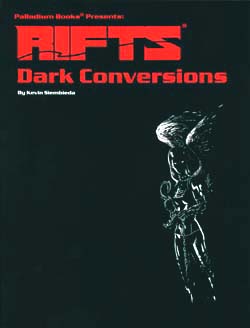
My Life As A Gamer: Rifts Dark Conversions

If there is any subset of supplements for Palladium's flagship line, RIFTS, the Conversion Books are it. You do not ever need any of these to make the most out of your game, and I say that as someone that likes them overall.

That positive sentiment includes the third in the series, Dark Conversions, which focuses on supernatural evil entities that originate in other Palladium lines such as Nightbane.

That said, if you do want to make use of Palladium's other offerings in RIFTS, this sort of thing should be on your acquisition short list. They're best considered as ready-made conversion notes, taking a lot of the guesswork and bitchwork out of your hands and making it easier to employ them in your game.

The entries, by and large, are a big heaping plate of copypasta with some editing here and there to give context for use in RIFTS and as such if there was ever a product to not bother with unless you're running the game this is it.

But there is something good here, and that's the rules for Nightbane in RIFTS. These shapeshifters come in a diversity of forms, so I find that their real value is not as beings from the stand-alone game of the same name, but rather as a ready-made Random Monster Generator alternative that's going to keep players who read too many books on their toes.

If you're wanting this sort of thing, throw it on your Wish List for a Grab Bag. Curate your list well and you'll get it.

Today's also Geek Gab day. See you folks in the chat.

Friday, November 13, 2020

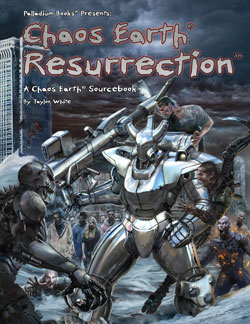
My Life As A Gamer: Black Fortresses & Zombie Apocalypses - "Chaos Earth: Resurrection"

Palladium's flagship game, RIFTS, has a prequel line: Chaos Earth. CE focuses on the period immediately after the Coming of the Rifts, which is about 300 years before the default time of the main game. It's considered a playable stand-alone line, but in practice it's best considered a parallel line for the main game, and these products show it.

Again, we see the lagging indicator thing at play. This was a 2015 release, coming after the last major wave of zombie films and just as shows like The Walking Dead made their mark. Palladium loves their mashups, often giving the impression of being that guy at the all-you-can-eat buffet that throws all the things on one plate and ends up with a stack of food a good two inches tall, so it's no surprise that they decided to do the zombie apocalypse here.

The premise is that an extra-dimensional techno-necromantic construct--The Black Obelisk--pops up and begins doing techno-woowoo in the form of an elecromagnetic signal that makes all corpses animated and go all Night of the Living Dead in the area. Once scoured of people to kill, the dead scavage all useful tech and bits and take it back to the Obelisk. They they march inside and get necro-borged into killer zombie cyborgs with the ability to boost the Kill All Living signal, march forth and repeat; usual "stop it or all life on Earth dies" ensues.

To its credit, there is no pre-determined outcome this time. There are win conditions. There are loss conditions. Players have agency to determine the outcome. There are also extensive notes on using this with the main game as well as with the stand-alone zombie game in Palladium's roster, Dead Reign; this, along with the beastiary, is what gives the supplement its value.

If there is anything to criticize, it's that they spent a bit too much space explaining the antagonist--and there is one; this is not Le Mindless Horde--because so much of what drives this antagonist simply will not come up in play. It is unlikely that players will even know that a specific sentient individual runs this threat until they encounter him directly; the only use for knowing the antagonist's story is to give Game Masters a persona through which to filter Opposing Force actions, and that's done with just a terse psych profile of a paragraph or two. It worked for Walter B. Gibson; it works for you too.

A lighter criticism is too much space wasted on things players will never see, and Game Masters will not put on the table, such as narrative introductions. RPG products are technical manuals. Do not waste the user's time; get directly and immediately to the point. The supplement is an addon to a thing--a tool, a machine--that the user uses. Tell him what it is, how it works, and--and this is key--how to use it properly to achieve the desired effect. Be clean, be concise, be consistent; get in, get out, get on with it.

TLDR: Worth it if you play any of the three Palladium RPG aforementioned.

Saturday, October 24, 2020

My Life In Fandom: Geek Gab Talks "Pinkerton's Ghosts" w/ Ben Wheeler

This week on Geek Gab the boys talk to Ben Wheeler about "Pinkerton's Ghosts".

And this is what they're going to be talking about.

I'll be in the chat, as usual. See you then.

Thursday, June 4, 2020

My Life As A Gamer: Most TRPGs Are Irrelevant

In light of this utterly fucking retarded display of incompetent by WOTC's D&D Lead Rules Designer, it's time to talk tabletop RPGs and why so few matter.

Let's start with a fact most TPRG publishers would rather deny: most TRPGs are irrelevant and can be safely discarded.

The reason is that most TRPGs bring nothing to the table that is truly worthy of attention. They can be--and have been--repackaged as supplements for a TRPG that does matter and do just as well or better commercially than being a stand-alone product. Why? They neither play sufficiently different from a relevant game to be notable, nor do they present a play paradigm that is done better in another medium, and both assume that what's being done is actually entertaining in and of itself.

You can, therefore, pare your TRPG collection down to three titles and cover everything of note that TRPGs as a medium offer you: Dungeons & Dragons, Call of Cthulhu, Traveller. In all three cases, you can even go so far as to not bother with anything but the original version of that game and do fine for the rest of your days.

The key is that all three games use separate, distinct, and novel gameplay paradigms that are entertaining in and of themselves without needing to resort to borrowing from narrative media in any way. D&D is properly focused on the exploration of dungeons and the recovery of treasure as a microcosm of exploring a frontier and claiming its resources for your settlement. COC is properly focused on investigating the paranormal and dealing with the consequences of encountering that which is beyond Man's ability to comprehend. Traveller is all about making your way as an intersteller actor in the far-future, with subsets focusing on merchant and military activities as most action involves one or the other most of the time.

Other well-known properties can be slotted into one of these three, and some hybridize them. Cyberpunk 2020 takes Traveller and scales it down into a single city. Borderlands blends COC and D&D, while Shadowrun blends D&D with Traveller. Some properties can be straight-up recreated within an existing property. (e.g. BattleTech w/ Traveller) Others offer nothing more than a novel sub-system and call itself a full game. (e.g. Champions, and superhero gaming generally)

I can go on for paragraphs, but the rubric above shows just how pointless most TRPGs are. The best thing that could be done is to identify what novel and entertaining bits a property possesses, and then rebuild it as a third-party supplement for one of those three games. (Successfully done with Legend of the Five Rings, not so well with Star Wars, both referring to their d20 System versions.) It is an expression of hubris to continue to insist otherwise when we have 45 years of data to show this to be the case, especially with regard to games chasing the D&D end of things.

This medium has shown via generations of revealed preference what works and what does not. If it were not for the lack of barriers to entry, most of these products would cease to exist by now, forcing either product redesign that conforms to the reality of the market situation or the creation of a Brand Cult that leverage the psychology of worship to compensate for the lack of product relevance.

TRPGs are products. Products exist to solve problems. It turns out that the problems solved by D&D, COC, & Traveller are what exists to be solved within the tabletop RPG medium as any other successful would-be solution ends up spinning off to another medium entirely- usually tabletop wargaming, LARPs, or some sort of videogame. This will be the case unless and until a new problem of entertaining gameplay is identified and addressed with a new, novel and in-itself-entertaining TRPG.

Saturday, July 15, 2017

My Life as a Gamer: Palladium's Three Horror Games

Palladium Books has three horror games in their catalog. The oldest of the three, and the only one to have a second edition, is Beyond The Supernatural. This game came out before the monster-as-hero picked up steam in film and television, and just started to get steam in comics, so it's best taken as being inspired by the horror films of the 70s and 80s. Player-accessible supernatural powers are limited to spell-casting and psychic powers; this game did Buffy the Vampire Slayer well before the TV series (and certainly before the licensed tabletop RPG).
This is a pre-RIFTS game, and it's meant to use the real world as its setting, so the craziness commonly associated with Palladium's games is a bit muted here, but if there is any movie that captures how the game actually feels in practice then go watch Cabin in the Woods. For a game meant to be low-key, the actual disparity of power required for a good horror scenario is often lacking out of the box; it takes a confident Game Master to make it work, something that too many lack.

When done right, you get the experience of a Hammer Horror film featuring competent protagonists. When done wrong, you get satire like Blackula. But there is another option, and that's the option that made this game stand out: the Victim rules. By default, the game doesn't do Slasher Films well; the Victim rules fix this, allowing players to be truly hapless and helpless before the horror they face, and forcing the players to be just as resourceful (and reliant on luck) as the stupid teenagers and co-eds of the films this option emulates. It has its fans, but most horror gamers stick to Call of Cthulhu in general or to another competitor for something more specific.