Showing posts with label car wars. Show all posts

Saturday, November 8, 2025

The Business: Network Effects Dictate If You Win Or Not

We're doing this. Too many of you either forgot or didn't get the memo.


YOUR LIFE IS GOVERNED BY NETWORK EFFECTS!

Tabletop is utterly dependent upon Network Effects for their value. Your fucking product is USELESS ASS-WIPING PAPER without a user network.

The reason that The Only Game That Matters is Dungeons & Dragons is because D&D has the largest user network. Every single user is connected to EVERY OTHER USER because they all play the same game. This is what Ryan Dancey got on about 25 years ago when he pitched the Open Gaming License to Wizards of the Coast for D&D3.X; time proved him correct and continues to prove him correct.

Every other competitor to The Only Game That Matters that did not tap into the dominent network faltered and continues to falter. The utility for anyone coming into the hobby to learn ANYTHING other than D&D is a diminishing utility that is fast eroding as macro-level economics and global geopolitics continues to collapse and shift. Why? Because this is a hobby billed on being dirt-fucking cheap to get into and stick with, which sets very firm AND very low expectations regarding cost- this is why D&D Beyond, despite everyone and their uncle complaining about it or about WOTC, is still where the majority of hobbyists are and remain to this day.

You cannot compete within the hobby while being without the dominant network. YOU CAN ONLY LOSE SLOWLY.

"but-"

You have the apperance of competition because people somehow think begging on a crowdfunding site is not actually begging, and because publication costs are so low now that very small operations can--even after the tarriffs--can crack out product without needing to be Big Corpo, but that it all it is: APPEARANCE. Seeming. ILLUSION!

In reality, there is D&D and there is Fuck You Get Lost.

The reason? The utility of a Tabletop product is physical; you can't play by yourself, so you must have others who agree to play and that means that the game that gets played is the one everyone agrees to play. That's going to be D&D 99% of the time. It's just a matter of what edition to play, and the rest is details.

Therefore there is only competition within a network, especially in Tabletop, which means there is only competition within the D&D Player User Network and the further you get from that core--centered around Beyond--the worse your commercial viability becomes. Wizards of the Coast does know this, which is why the smarter people in the corporation decide to exploit that position at every turn; they just suck at succeeding at exploiting that position, but it doesn't matter because--contra D&DTube's Usual Faggots--alternatives to The Game That Matter are irrelevent because everyone does not agree on what to play other than D&D.

You have legacy subnetworks out there--Palladium being the oldest surviving one that still matters--and they survive by tapping into that D&D network through familiarity or similarity to a D&D edition, and you can slot the OSR into this for the same reason; it's why so many of them are/were B/X clones or built on those bones (e.g. Mutant Future cloning Gamma World).

The few other notable Tabletop properties out there are likewise Old As Fuck and remain on top because they are the dominant property through a dominant Network Effect, and so many of them have reached Escape Velocity where it no longer matters if the game itself is in print or published by this or that corporation or whatever; BattleTech was an outright dead game for years at a time and it still dominated Giant Robot gaming in Tabletop, with Heavy Gear only ever as a Number Two, and that's how D&D is overall.

(N.B.: This is why Star Wars in its d6 form remains so dominant despite there being d20 and Whatever That Fucking Abomination Is. Furthermore, it shows that 40K and Fantasy can be maintained should G-Dubs ever completely lose the plot.)

Tabletop has not been a Blue Water economic sector for generations; it was saturated by 1980, and crowded by 1990. The last serious shake-up was D&D3.X and Dancey's attempt at applying Copyleft principles to Tabletop, and we saw what happened as soon as he was out of the picture; at least that fuckup ended with the release of Current Edition into Creative Commons, and the forking of 3.X into Pathwanker, but in terms of actual "I am a serious businessman pursuing serious commercial endeavors" Tabletop hasn't been shit for dick since 1980. If you're not a Boomer or a Joneser, you're not a real player and you never were.

The hobby's commercialization was a gross mistake, one that entropy itself is now correcting, through the relentless power-flexing of the Network Effect. It no longer matters what WOTC does or does not do; D&D is now the Forever Game, with a Network Effect that cannot be beaten because it has escaped the control of any IP owner or controller, and thus it is to Tabletop what Xerox is to photocopying or Google to search engines- no, even worse.

This is why I say "Just play D&D". If you actually want to play, that's how it is and now that's how it will always be. The next Traveller edition will (again) be built on D&D's bones, and all of them will in due course. You go where the action is, and the action is the Network.

Friday, September 26, 2025

The Business: You Can't Ignore Gravity Forever

Conventional Play is aware that there are too many products chasing too few dollars and buyers.

What they are not accepting of yet is that "too many" is "More than a handful, after D&D". Most of Conventional Play is not commercially viable; they are delusional, but increasingly unable to maintain that delusion. I am now seeing that those able to break their delusion soon will be able to downshift to a self-financing hobby successfully, using crowdfunding to finance operations and offering premium quality books for backers while going POD thereafter to eliminate overhead. Everyone else will fold and shit down; no one will follow WOTC to Vidya.

Other Tabletop sectors are set to follow this trend as Network Effects play out there to the same end. Miniature wargaming is 40K, BattleTech, and Random Shit No One Plays; historicals are already well down that path, with Napoleonics still on top overall followed by World War 2 and Random Conflicts Most People Don't Care About. CCGs? Magic, maybe L5R, and Shit No One Cares About (which is sad, because Shadowfist is not a bad game). All of them are already showing signs of doing more or less the same thing: going self-funded hobby mode, defacto or de jure, and downscaling thereafter to conform to market realities. (CCGs would benefit greatly by selling the actual card graphics tied to a user-only print-at-home license, provided that they are printed on proper card stock.)

The realities of the market can't be ignored forever. Only The Only Game That Matters is truly viable; others can struggle to make a fragile niche, but they'll never break out of that struggling state and as soon as the one figure keeping it together is gone so is that other thing.

Not ever cultural artifact needs to be profitable to be worthwhile.

Tuesday, March 4, 2025

The Culture: Geek Gab Drives Offensively!

Geek Gab hosted Jay Barnson, author of DEAD TO RIGHTS, on Monday of this week. After the movie and TV reviews, we get to the meat of the show.

This is a Car Wars novel, the latest in a series. It's been years since I'd seen anyone publish any fiction related to Car Wars, so I am curious about how good these are.

Given Amazon's recent policy fuckery on Kindle, I am suggesting Paperback if you buy from Amazon.

While Jay's got other things to offer--see his site page--the Car Wars series is one I want to focus upon. There's not a lot of stories with this premise, be it set in the (now retro-)future of Car Wars (we are closer to this than it seems) or something (legally or more) distinct therefrom, these days and there wasn't a whole lot back in the day either; if you found it, you likely found all of it.

Unfortunately, this sort of thing--more technologically sophisticated then Mad Max (which is a fantastic game in its own right), but still in the general vibe--is rare in general in entertainment. Games Workshop, back in the day, had Dark Future and that was about it. (Yes, Thunder Road is a thing; it's Mad Max with the branding filed off, and that's not Car Wars.)

This dystopia is a cyberpunk dystopia before Tabletop had that term, albeit lacking on the cyberware and chrome. You've got megacorporations, hypercapitalism, weak governments, ultratech gatekept by stupid high price tags (and the transhumanist horror it provides, like Boomers Never Dying Off). All you need to do is ensure that Dudes In Cars With Guns solve the problems and you're cooking with gas. Make it happen.

Tuesday, February 25, 2025

The Culture: We Have Found An Effective Tool To Unfuck The Hobby

This gal came across my feed a week or so ago. She's a professional freelancer in the fiction world. She upset the OldPub hive.

While she's worth your time if you care at all about Men's fiction and men writing fiction that gets and keeps an audience, that's not why I'm pointing this video out.

No, it's this Comment:

@Stinky-Pete 2 hours ago

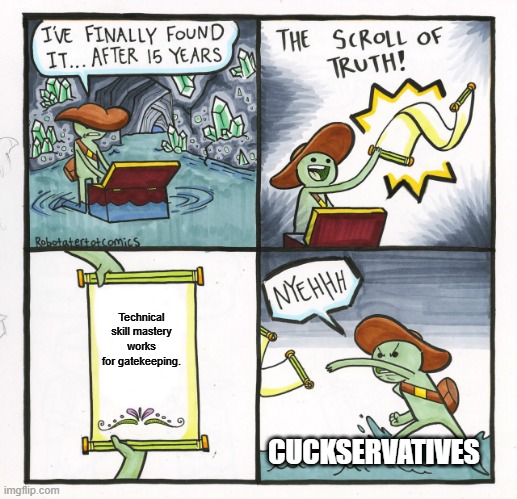
This problem is going on in almost every form of male escapism for the past 15 years. The only male dominated entertainment/hobbies left untouched from colonizers are ones that take mechanical or technical skills (cars/wood working/model making/etc.).

I've bolded the important part.

Consider the changes in The Only Game That Matters over time. What has been done with every edition? A slow degradation in the necessary technical skill and literary acumen needed to play the game properly. The latter was the first to go, and with the last two editions the former fell away too.

It is no surprise that the things that took away the need to be technically proficient--Virtual Tabletops on the tool end, disdain for procedure on the cultural end--coincided with the feminization and infestation of the hobby by the Death Cult due to Mammon Mobsters doing things to make Line Go Up.

This squares with my position that the Real Hobby is an inherently occult practice best suited for the Clubhouse and its fraternal environment, and it explains the hostility for the positions that the #BROSR advocates- especially Rules As Written. It's a revulsion at the idea that there is a technical skill requirement to use the machine properly. It betrays a failure of the objector to conceive of something entirely in the unseen realm as being real- it is the rejection that Ideas Are nouns, ARE THINGS!

The machine that exists in the manual is still a machine even if no one builds it. That is what a Tabletop Adventure Game is. The fact that several of them have been turned into literal machines--videogames--proves this.

The way out is to RETURN HARDER to games and game design that demand the cultivation of technical skill and acumen to successfully participate. Returning to the wargame roots is a necesary element to achieving that end, and in so doing the cultivation of fraternal bonds is going to happen because without that you don't have a viable Clubhouse for long.

The Clubhouse is the Dojo.

Start demanding technical competence!

Saturday, February 15, 2025

The Culture: You Don't Need The Widgets To Game

Tabletop Moron shares OPINIONS!

There is one thing here that Moron exhibits that is actively detrimental to the cultivation of wargaming: the insistence upon including terrain and miniatures as requirements to play. His shot at BattleTech (originally played with cardboard maps and cardboard standees, still playable now with counters and a paper map) proved this. He has Warhammer Brain and it affects all of his OPINIONS.

Fuck no, minis and terrain are not required. One of the best wargames published proved that over 40 years ago.

Let me say this louder for the folks in the back.

WARGAMING IS A CHEAP HOBBY WITH STATUS ANXIETY!

The reason for Warhammer Brain--what I call the insistence upon requiring miniatures and terrain to be considered "real wargaming"--is because publishing tabletop wargames is not commercially viable otherwise.

Games Workshop pushes minis in particular because that's what makes the money- not the games. They change the game for the same reason that governments under Modern Monetary Theory (all of them) impose taxes: to compel the adoption of the widget associated with it (minis/currency).

The thing that people forget is that the game plays the same with counters and a paper map. You can play 40K or Fantasy or Shitmar just fine with a Ziplock bag full of counters for each army and another for terrain- something G-Dubs is desperate to keep people from doing for very obvious reasons. Kill the sales of minis, paint, terrain, etc. and most Big Tabletop companies like GW suffer a stroke and die.

GW (and others following its lead) uses the Cult of Officialdom for the same reason that governments shove guns in your case: to pressure you to adopt the widget. Unlike guns, cults run solely off social pressure- dilute the pressure and the cult loses power. GW's practices are no help in maintaining that pressure, and having Death Culists in their ranks only makes it worse for them due to incompetence.

Yes, you can just cut a series of counters and put art on them for your army. GW can't do shit about it. Yes, you can just throw down a vinyl mat and use overhead projector pens to draw terrain features on it. Yes, you can--and, given how some armies are meant to operate, should--use far larger tables than they say; hell, you could (and should) just play on the floor. If literal War Colleges can do it, you can.

GW's brand cult relies on unthinking Consumerism, which in turn relies on you thinking that you have to have the widgets to play. You don't. The game is not the merch; the merch is not the game. (The Network is not the Brand; the Brand is not the Network- you see this every day when some YouTuber does a React video to one of Bricky's Intro to 40K vids.)

You want a viable resistence to the Stupid British Toy Company? Start playing without the widgets. Counters, paper maps, ad-hoc terrain- whatever it takes to reduce the cost as close to zero as possible. Then pirate the rules and strip out all of the Coffee Table bullshit bloating up the page count to get at what the actual Technical Manual is; clean that up and distribute that instead.

Now you can play The Game That Matters without giving the shitbags in the UK a penny. That is effective resistance, and GW knows it.

So, regarding D&D, does Wizards of the Coast- which is why they too are going full Brand Cult and will do what they can to get that same cult pressure going.

You want gaming to be a hobby again? Kill commercial viability at every turn. That's how it has to be.

Monday, December 16, 2024

The Business: Lore Proves A Lack Of Commercial Viability

Another Jeffro observation:

This follows from another well-known complaint about Conventional Play: No one gives a shit about your fucking lore.

Lore creation by publishers, especially by people paid via Work For Hire contracts, exists solely to build up the property as a Brand for non-hobbyists to consume. As with what Jeffro said about a few related topics:

Players really don't care about your big brain house rules. They already don't want to listen to you talk about your campaign updates. They definitely don't want to hear about your "lore". House rules? Even less so.

The BEST source of campaign information of ANY kind are OTHER PLAYERS recounting their experiences or else mentoring each other on sound tactics and strategies. Ideally, the referee should be the most boring person at the table.

Back to the Lore matter: the purpose for Lore, for a publisher, is to develop a Brand that is better suited to a Narrative medium: film, television, comics, novels. Not games. A competent publisher, in developing such a body of lore, does so with the aim of creating a Series Bible for the Brand that hired guns and corporate partners will adhere to when doing work for the Brand. (Note: There are no such publishers in the hobby. NONE!)

Lore can be consumed without participating in the game that it came from, which is the point of its existence from a commercial perspective. The ongoing success of lore channels for BattleTech and 40K and Fantasy show this in action, and thus become unpaid Brand Ambassadors doing marketing for the Brand.

Over time this non-gaming audience will grow to eclipse the hobbyist audience and the publishing operation will pivot operations to cater to this new audience over the original, eventually to discard it entirely as a legacy element that impedes the Brand-focused business that the publisher has become.

Games Workshop is already well down this path, as is Wizards of the Coast, and a lot of corporate business media pushes the drive to depreciate the original core audiences in favor of the more numerous non-gaming one attracted by the Brand-focused material that lore publication cannot help but to attract.

If you are a commercial operation in the hobby, you have no reason to not go down the route of writing reams of lore because this effect is a desirable consequence- assuming, again, that you are a competent operation. A mature form of this business has no in-house ludological capacity or acumen at all; that's all licensed out to corporate partners- just look at Hello Kitty as a successful example.

(This also puts the lie that Tabletop gaming is itself commercially viable; if you have to spin off subsidiary product pure to use as leverage into a different medium and business where the actual money lies, you are not commercially viable.)

An honest hobby publication, operating on a non-commercial basis, has no need to do anything but to produce a competent technical manual for the hobbyist game and then leave well enough alone. The hobbyists, as end-users, will take that turnkey product and make their own content to use with it through playing the game as the manuals command them to do. There is no need to publish lore, including setting material; let the users do that themselves, for they shall do better than you ever could.

That is what AD&D1e and several other classic Fantastic Adventure Games allow; that they are not exactly just a set of technical manuals is a flaw put into the design due to commercial incentives. The rest are lobotomized crippleware meant to enable Endless Product Slop, through which they can also enable Endless Lore Publishing and thus turn the product into a Brand that becomes the road to where the money is (and thus the path to selling out).

This needs to stop for the good of the hobby. Destroy the slop and the lore. Replace it with teaching, training, and building up new hobbyists; the Clubhouse is the Dojo.

Monday, June 17, 2024

The Culture: Videogames Superseded Tabletop For Conventional Play By 1980

Do you want to know why I keep harping on Conventional Play being surpassed and superceded by videogames?

What do they go on about? "Muh Narrative" (read a fucking book, and not the wizard book) and "Muh One True PC/Party".

That got solved by 1980.


This is where "Rogue-like" came from.

The following year, Conventional Play had its first Muh Narrative videogame.

Which would soon have others joining the party over the 1980s.


SSI's Phantasie would join that list by the end of the decade alongside the officially-licensed Gold Box AD&D games.

Now add in the Japanese games such as the long-running Final Fantasy and Dragon Quest series, then arcade games for more fast-paced versions, and it becomes very easy to see why those not already involved in the tabletop hobby by 1990 presumed that "RPG" meant "videogame genre".

Yes, 2nd Edition. Yes, Palladium. I was there; I remember.

And I recall that getting anyone to play any tabletop game at all who was not a Gross Nerd was like pulling teeth, and then it was 2nd Edition, The Anne Rice Game, or Uncle Kevin's Kitchen Sink Non-Game (which still has the best wholly unintentional tie-in movie adaptation).

They were right to refuse, and not just because of who did the pitching.

They didn't have to round up a bunch of people to play. They didn't have to put up with bad behavior. They didn't even have to worry about purchase prices because by 1990 we started to see rentals be a thing.

They had a better Conventional Play experience before Ronald Reagan left the White House.

You had something closer to the real game with folks playing Car Wars, BattleTech, and SpaceMace 39K.

Meanwhile, people now going on about how they were playing the real game all this time were deep into Not Teaching Hobbyists What They (Claim To) Know like the Boomers they are.

And folks wonder why I say Conventional Play in Tabletop is screwed.

The fight got lost nearly 45 years ago. It's been nothing but a long, slow defeat ever since.

Why should I stick with a losing proposition when videogame alternatives are 100% superior and the real game gives me all I ever wanted from this hobby. Tabletop Conventional Play has never delivered, and it cannot deliver, so I welcome its demise in Tabletop.

And you can take your wretched "industry" with you.

Monday, May 6, 2024

The Culture: The Need For A Forever Edition

The Recognition of the Need

One of the things I noticed with the serious exploration of Advanced Dungeons & Dragons 1st Edition is that having a single, settled, static edition of the game turned out to be a massive benefit to attracting and retaining new people.

Having a ruleset that does not change because it is not subject to commercial considerations is a massive boon to any hobby campaign built upon that cornerstone foundation. This is confirmed by how Car Wars and BattleTech endured for so long despite neglect or even hostility by the controlling Publisher; the rules manuals could be had online, and before that the used market, that remained as they were since publication as well as less-than-legal sources (photocopying and mimeographing).

Therefore the conclusion is obvious: a stable, healthy hobby scene cannot be subjected to Edition Churn. It must use one unbending, unyielding, unchanging Forever Edition such that someone learning the game today learns exactly the same rules to play exactly the same game as someone a thousand years from now.

Yes, this means that Product Development is going to completely change. Good.

The End of The Consumer Product Cycle

Rules are not shoes. Rules are not cars. They are not goods to be used, worn out, and discarded when no longer fit for purpose.

Rules are like software, in that it is a pile of mechanics and procedures that operate like a machine. They are better than software in that you do not need electricity or a computer to use it.

That means two things: it is possible to hit "good enough" during development, and it is viable to aim for "perfect" as the end goal of development. The former term is self-explanatory; the latter merits qualification, so here it is: "Perfect" is defined as having achieved a state where any further changes can only damage the ability of the rules to achieve the stated outcome to be had by playing the game.

"Good enough" is where development starts. "Perfect" is where it ends. The transition between the two is what development is: the refining from a rough, but usable concept into the final finished product that does what it is meant to do- no more, no less.

That this is at odds with what is considered Best Practices for commercial operation, be it in physical or in digital products, should not be a surprise to anyone. Edition Churn is a commercial practice that is at odds with the fostering of a healthy hobby environment, and it has been known as such since Stupid British Toy Company deliberately weaponized it as a business practice in the 1980s.

This practice needs to be taken into the town square, strung up at the gallows, and hanged for all to see before being doused in jet fuel and lit up to burn to ash.

There is one very obvious reason for why this needs to die: it is no longer necessary to do this at all.

The technology now exists for a rules manual to be posted online for all to see, and to study, at their leisure. It's been around for over 30 years at this point; there is no need for anyone to churn editions anymore for any form of tabletop game of any kind. Put the rules online; mirror that site, make PDFs available for offline use, and sell Print On Demand copies at-cost.

Once the rules have achieved their final form, lock the site down as well as its mirrors. Do similarly for the PDFs and POD listings.

Now you have that game that shall be the same for the rest of time. Good.

But Why?

To kill the threat that Muh Officialdum, almost always fostered as a headscrew by Publishers to weaponize Fear Of Missing Out to induce a cult-like dependency upon the Publisher via control over the Brand, has upon a hobby.

If a rulebook from 10 A.D. and a rulebook from 3010 A.D. are exactly the same, then the Hobbyists will be able to enjoy the game for generations on end without any worry that some dangerhair dumbass, some status-striving slut, some grifting guru, some poncy politico, etc. will seize control over the game via legal fuckery and shit-can the game and its Brand.

Keeping cultural institutions out of the hands of obvious attack vectors for bad actors is part-and-parcel of good stewardship over one's culture. That includes games, especially those who have a habit of teaching people ideas and practices that some folks would rather not spread around.

Tuesday, April 16, 2024

The Business: Oh Hey, More News That Conventional Play Is Fucked

There is one other reason to embrace the need to fork away from the dumb and return to your hobby being an active pursuit and not this:

And, for those following this story, it is no surprise at all.

Let me dial it up for the hard-of-hearing out there.

THIS IS NOT THE SIGN OF A HEALTHY CONSUMER MARKET!

You think that Stupid British Toy Company is immune?

Like their counterparts out in Washington State and Floria, Dumb Toy Corp. will lie through their teeth as their business withers, collapses, and dies- including to their shareholders, and will increasingly engage in shady (if not illegal) practices to maintain control and further the Death Cult agenda.

So. Fucking. What.

The hobby is not the corporation. The hobby is not the Brand. The hobby is the audience that partakes and enjoys the hobby, and the hobby does not need the corporation or the Brand.

Rules can be copied and shared online for free. STL files means that anyone with a 3D Printer can make their own minatures, just as traditional printers means that anyone can print their own counters or 2D stand-ups (e.g. Car Wars, BattleTech) as well as their own maps. Terrain? Dude, hit up any hobby shop that deals in dioramas or model trains or any craft store and you're golden. (I cannot count how many '90s BT games were on barren rocky worlds because we just used rocks from outside and SOLO cups as terrain on a bare table.)

"But I like the lore."

Nevermind Axanar (and that is a convoluted mess of a story to itself), you have audience-originated works that are still used as go-tos for people: Astartes, SODAZ's 40K videos, Hired Steel (for BT), and the entirety of the "Tex Talks BattleTech" series- now followed closely by Sven van der Plank's videos (also for BT). Arch and Luetin09 are still better storytellers for SpaceMace and Fightstick than what Dumb Toy Corp. employ most of the time- and there's plenty of others that are about as good as they are, including for games other than those two (such as BTech). Buddy, the audience does this better.

And with sufficient social pressure, they can and do cave. Refer to the example of the UrbieLAM from yesterday- a shitpost memed into existence and bullied into acceptance.

The Hobbyist Rules The Hobby

Everything else is justified so long as it serves the hobbyist. Once it no longer does, it is unfit for purpose and must be destroyed. We are seeing that come to pass now.

You know what your options are by now: Quit for Vidya, Quit Entirely, Return to the Clubhouse. The hobbyists will be at the Clubhouse, sharing files and making terrain when they are not playing at the table.

And those Twitter Freaks, Tourists, and Death Cultists trying to turn the hobby into Art Therapy Hour? Gone. They never wanted what we had; they only wanted to take it from us, and they are about find out that you can't steal what exists between one's ears, so once they figure out that taking over the corporation doesn't take over the hobby then they're going to freak out- those that don't An Hero will flounce off to bother someone else.

But what I pose to you is this: Consider that the real mistake was going mass market and corporate in the first place. Over half of the problems we summarize with "Conventional Play" would not have happened if that did not happen. Hobby pursuits need to remain within the hobby scene.

Monday, April 8, 2024

The Business: Operational Tempo & Proper Campaign Play

There's something else that needs to be kept in mind when we talk about how Vidya beats Tabletop for a lot of adventure game stuff.

Vidya, for certain games so far, does a far better job realizing how a man in that environment has to think and act to succeed than on Tabletop. The game that illustrates this best is BattleTech. Both the Harebrained Schemes adaptation and the Pirahna Games one handle all of the actual campaign stuff better than tabletop because it's shoved into the faces of the typical player; you have to master logistics to win the game.


Streamer commentary makes the experience so much better.

Notice that both of these games have their own ways of doing Conventional Play's disregard of Strict Timekeeping because both of these are single-player games with no pressure upon them by hostile actors; they are both games with Narrative at their core, so you have to trip Plot Triggers for things to happen that matter- just like Conventional Play.

When you go to an Open World mode of play (which both of these videos do), even that is gone. You can do all the refits, train up pilots, go wherever, and the only costs that matter are time and (sometimes) availability. Yes, this is exactly same thing as the old joke about JRPGs where you have to Save The World Right Now, but you spent as much or more time doing sidequests than the main quest because that's where much or most of the game is.

As JD Sauvage said on Twitter the other day, Operational Tempo matters. Conventional Play does not have this. It cannot because it is taken as Referee cheating players, and due to several infamous episodes that got turned into comic strips and running jokes there is substance to that seeming.

Pressure comes from outside the player. Want your man to get that loot in the dungeon? Got to get down there and grab it before some other man does, and that someone else is run by a player- not a NPC run by the Referee.

That player can be you, as you may be forced to bench your first choice man due to what goes down at the table and have to resort to a backup choice to secure that bag instead. (Get used to the idea of having a roster of mans when you play in a real campaign, rotating them on and off the bench as required.)

That player can also be someone else, whom you do not know, and you will not know until that treasure is taken or otherwise removed from the campaign and thus no longer relevant.

That's how things really work when you play a real tabletop adventure game, and you play it in a proper campaign environment. It will not feel like a Narrative; it is not play-acting. It will feel like war, like business- like the competition that it is. Sometimes you win, sometimes you lose- and sometimes you win or lose for reasons that have nothing to do with you.

And the experience is vital to achieving the full power of the tbletop adventure game as a medium.

Thursday, April 4, 2024

The Business: From The Other End, Boardgames Are What Conventional Play Claims To Be

I mentioned boardgames yesterday. Coincidentally, Roll For Combat had two Chaosium boardgame developers on this week.

I want you to take this in, Anon: a increasing number of Conventional Play publishers are coping with tabletop's collpase by pivoting to board, and card games.

Some got out entirely, some merely depreicated their adventure game products. You know some of their names very well: Games Workshop, Steve Jackson Games, Fantasy Flight Games, Atlas Games, Catalyst Game Labs (regarding BattleTech).

Some you don't know, but you know the Brands: Heroquest, Dungeon, Pandemic, Talisman, Settlers of Catan, Orcs At The Gates.

Why are boardgames eating Conventional Play's tabletop territory from the other end? Let's again look at the costs.

The Tabletop RPG

Current Edition's trio of core rulebooks retail for $50 USD each. That's $150 for the Referee, plus tax. Most players also use a premade campaign module; those vary in price, so let's call that $30. Now we're at $180 for the Referee before taxes and other fees. Players, as often as not, freeload unless they're subscribed to D&D Beyond (and many are).

Then there is the cost in time wrangling players, convincing them to play the module that the Referee wants to run, screening out shitters and similar problems- i.e. time spent Not Playing. That's time where players can easily dip out because someone ready to run something appealing right now does that, forcing you to waste more time wrangling players.

(I direct you to every RPG forum ever for all the threads and videos all about that nonsense.)

Now all the 20 Minutes In Four Hours stuff, Scheduling Your Fun, etc. stuff comes up, and good luck going past six sessions.

That's a lot of money wasted unless you're on the ball both in the selling and in the running, and thanks to Matt Mercer that's a high bar to to clear these days.

The Boardgame

Heroquest is available at Amazon for $84 USD (plus tax). All you need to play is in the box.

You have an easier time finding players for one big reason, same as yesterday regarind Vidya: No Ongoing Commitment. Players can show up one night, play a scenario, and then be gone for months at a time missing nothing because Heroquest (and those like it, such as Dungeon and Descent: Journeys In The Dark) doesn't assume static groups with job-like commitments and con-commitment scheduling.

The game is simpler, easier, and faster than Current Edition across the board. The game teaches itself as you play. That's a massive win right there; the boxed set will have as much or more Actual Play value than the Current Edition campaign module and you didn't have to spend additional money to get it. For most, this is plenty enough.

And mind you, the cost for that boardgame is in the components; Cheapass Games proved many years ago that you can get all the quality gameplay with an envelope full of cheap bits and ask users to raid the Poker and RISK sets for tokens and dice. (God bless Spree! and Huzzah! )

The lack of Serious Business means that you can have Board Game Nights and maintain a party atmosphere; a sufficiently large turnout opens the door to making it a Clubhouse, and the most popular such games regularly find itself brought out at social events (e.g. Apples To Apples) because the combination of simplicity, learn by doing, and easy social lubrication (like why Poker and Rummy are perennial favorites).

(I need to update the Wish Lists again. Kill Doctor Lucky is great fun.)

They are cheaper, easier to use, easier to play, have no ongoing commitment, and have social proof IN SPADES. This is why they eat Conventional Play's lunch.

You could bother to learn from this, Conventional Play bros, but those of you that could already have and made the pivot a long time ago.

Those that remain, well, you're in for a bad time unless you wake up and adapt fast.

Tuesday, February 13, 2024

The Business: The Road Not Taken Soon Shall Be, Like It Or Not

In The Beginning, The Hobby Took One Road

Back in the 1970s the means to make a business out of fantastic adventure games were as they are now:

  1. Sell lots and lots of product.
  2. Sell a subscription-based service.

The first is what the Cargo Cult gravitated towards, such that "The Product Treadmill" became synonymous with the business of hobby game publishing. Cripple your core game to make room for supplementary publishing, add additional products that are really there to launch and develop a specific Brand (i.e. Setting Bible Syndrome), and keep at this with decreasing end-user utility until it collapses under its own weight. Reboot with a new edition and do it again for another 3-10 years; this is the model that Stupid British Toy Company is infamous for openly espousing to its investors, especially with SpaceMace 39K.

To the credit of preceding generations, there were attempts at the service model. This was were you found the RPGA, the AADA (Car Wars), Traveller's Aid Society, and other similar attempts to have the publisher of a given game product faciliate users' connecting with one another. But that is what they were: attempts. Due to a lack of infrastructure and resources, pre-Internet attempts focused around the convention scene- with all the downsides that has. Each would, in time, end up subserviant to the former- and to the Consumerist Brand Identity development that each would resort to over time.

It is not surprising, therefore, that any serious game design talent that began in tabletop fled it once they realized that this was a terminally broken business paradigm- and no one in a position to unfuck it had any interest in doing so.

SPOILER! It did. A lot.

When One Road Washes Out, Take The Other One

Years ago, back in the hive of scum and villainy that is RPG Net, I said repeatedly that the real money is in connecting users.

Now we see that The Only Company That Matters that publishes The Only Game That Matters agrees. Why?

Simple: the technology caught up to the vision. The problem all this time was finding a way to not only get users of a particular hobby game in contact with one another, but to faciliate their playing with one another. It took A RIVAL MEDIUM'S BIGGEST SUCCESS (World of Warcraft) to get any serious talk going AT ALL.

The current C-Suite at Magic-Users By The Water seek to implement the subscription-based-service model with the next iteration of Current Edition. They seek to be predatory about it, as befits people with mobile trash game business experience--that's the Zynga element, not the Microsoft one--and supplemented with more old-school experience (MS).

The new business model is to sell you a subscription, which grants you an access pass into the Walled Garden. You will then have access to Current Edition, and be able to connect with and play with other users. There is bound to be FOMO-driven microtransactions of an aggressive and predatory nature, creating a metagame layer intended to use peer pressure and Social Proof to get users to spend big money on things in the online/ingame cash shop (overpowered Races, Classes, whatever; we'll be wretching out our lunches over it soon enough) or you'll get benched in favor of those that do.

Sounds horrible, doesn't it?

It doesn't have to be that way, Anon. You have another choice.

The Clubhouse awaits all those ready, willing, and able to play the game properly.

Wednesday, December 27, 2023

The Culture: My First Clubhouse Campaign

The first time I encountered the concept of "the clubhouse campaign" was back in the 1980s. But it wasn't Advanced Dungeons & Dragons 1st Edition; the Boomers had already failed to pass on that vital information by then, to disastrous consequences.

No, it was a silly tabletop wargame with a weak RPG element, and it's still got a solid audience to this day.

Yes, I am aware of the new edition.

No, I don't like it. This is a game that needs to be cheap, not expensive, and readily available; counters, paper maps, and standard six-sided dice do this while miniatures, high prices, and non-standard dice do not. (It's what keeps me from Gaslands, which is a better version of what Sixth Edition is after.)

What made it ideal was its core gameplay: arena combat with armored cars.

You had war-as-sport in the autodueling arenas of a collapsed North America, you had bandit-v-convoy scenarios on the dangerous roads beetween the walled and armed cities, and you had plenty of room for small-scaled conflicts to nontheless influence bigger conflicts between bigger powers.

And you had the ability for celebrity to bridge the two tiers of play. A really skilled road fighter could move into (and out of) arena fighting, taking the street cred he earns taking out bandit gangs and using it to get himself famous in the dueling arenas, which gets him sponsorship deals (and makes him a target in turn) and similar opportunities.

And it didn't take itself deathly serious. The Boy Scout Commando Corps was a thing, the "bad guy" counterpart to the American Autodueling Association was Big League Unlimited Dueling (BLUD) so you had a Babyface-Heel dynamic going on, and you could see the spirit of Smokey & The Bandit, Convoy, Cannonball Run, the classic Mad Max films if you were familiar with the zeitgeist behind the game.

I was in a Car Wars club back in the day. Never won the club championship, but only once did I get wrecked something fierce. Because of the collapse, there was always danger and opportunity to be had outside the city walls, but there was also no viable alternative to over-the-road travel either hence arena combat juxtaposed to road combats was an easy thing to do.

Add in trucks, big rigs, choppers, bikes, and later on boats and hovercrafts for people to ride around on (when not on foot) and you had plenty of fun times- all of which could be done in a small area and mapped to a calendar like you do with AD&D1e, Gamma World, Boot Hill, etc.

You may not be able to get the classic edition from Steve Jackson Games for much longer, but you will find copies being sold used. Get on this; it's fun.

Wednesday, December 20, 2023

The Culture: Games For Clubhouses

Since Christmas is about to hit, and folks are doing that last-minute thing, some suggestions:

I'm keeping the list short to avoid Analysis Paralysis. Feel free to add others in the Comments below, along with purchase links. As almost all of this stuff has been around for decades, you'll be able to find them used; Half-Price, Abebooks, Alibris, Books-a-Million, Noble Knight, etc. are all worth hitting up in addition to the used section of any local stores. (That's where you'll find, for example, Renegade Legion.)

But here's how I'm judging them:

  • No modules needed.
  • Can be administered in the proper manner as explained by the #BROSR.
  • Can be run exactly as-written without issues arising from unanswered logical questions that the rules or the source materials ought to cover. (e.g. if Bob is laid up, how long would it take for my man to get to him to finish the job; how long does it take to go from putting in an order for a new-built ship to taking delivery of it)
  • Has either very obvious content creation procedures or very easy--and handy--tools to do so (as this replaces modules).
  • Thrives under a clubhouse campaign environment, where you have player-run tables overseen by a campaign Referee.

There's other products available out there, and sifting through the used market, that fits these criteria; there are also plenty of products that get filtered out. Some may surprise you.

Friday, September 15, 2023

The Campaign: Mechanized Adventure Campaigns

As the saying goes, "Amateurs study strategy. Professionals study logistics."

Fantastic adventure wargames are no different, and nowhere does this become more obvious right away than when the adventuring scenario involve mechanization.

Be it Traveller, Twilight 2000, RIFTS, Robotech, Mechwarrior/A Time of War, Battlelords of the 23rd Century, TORG, Heavy Gear/Jovian Chronicles/Gear Krieg, Cyberpunk, Shadowrun, etc. you have a milieu where adventures rely on using tools that have significant wear and tear just from intended use as well as consumables like fuel and munitions.

What does this mean? It means that there is an implied economic element to successful play, economics means logistics, and logistics (a) means mandatory downtime and self-generating scenarios for gameplay.

Guns need ammunition. Explosives (including missiles and rockets) need to be replaced. Machines need repairs, great and small alike, which means parts (etc.) need to be sourced and labor employed in spaces capable of allowing (if not improved to facilitate) such work- shops, factories, yards, etc. Vehicles (and some other things) need fuel and have limited range.

The stupid thing to do is to ignore all of this. Conventional play ignores all of this because players whine about it being inconvenient. Conventional play is stupid.

There are ways to handle this.

Tuesday, May 31, 2022

My Life As A Gaming: Even Fantasy Gamers Need To Know Their History

The title is misleading. This is really a recap of the Battle of the Atlantic in World War 2, dominated by German U-boats vs. Allied surface and aerial assets.

Indy talks a lot about technology and doctrine, but I can put it simply: the Allies forced the Germans into killzones and pounced upon them. The bait were the convoys and all the goods needed for the United Kingdom to stay in the fight. The killzones were the spaces created between the bait and the escorts, complimented in time by intelligence provided by aerial reconnaisance and signals intelligence intercepts.

It took a lot for this to come together, but the results speak for themselves and if such a similar situation were to arise now you would expect to have all of these elements reassert themselves swiftly to recreate those killboxes and replicate those results.

Therefore, I ask you this question: put in the position of someone looking to do commerce raiding to drive an enemy power out of the fight, and with this history informing your actions, what do you do to avoid this scenario repeating itself?

It's an interesting scenario question, isn't it? Now apply all of this to your campaign--even fantasy games, since they have stealth and piracy is a thing--and you see where I'm going with this. The historical record often has fantastic events in its pages, events that are going to come up organically in your own fantastic adventure gaming and fiction, and the different trappings don't change the fundamentals.

Imagine, for example, that you're playing in Jeffro's Trollopolous and you want to bring a hostile city-state to heel. Choking off the trade that supplies it with what it cannot produce itself is part of a siege campaign, and that's what the Battle of the Atlantic was. Imagine that you're playing a Macross campaign; you're going to want to find out how the enemy is supplying itself with the food, men, and material that it requires to wage war against your heroic Valkyrie squadrons and the idol singers that love them. You can be the First Lord of the Star League, the Emperor of the Galactic Empire, Warchief of the Horde, or a free captain on the Sea of Stars who's skull banner means freedom, dealing with this scenario in this manner is the same process.

Therefore, regardless of what genre your scenario claims to be in, you are dealing with the same things. If you can answer the above hypothetical in real world terms, you can answer it in any fictional context. This is why the better fiction writers always have a handle on real world history and current events, and make reading about it part of their routine; it makes the fiction better by providing it with the vital substance of reality without the drudgery that often comes with it.

And that is why real RPGs--real gaming--as the #BROSR lays out--is the real hobby; real gaming is wargaming.

Sunday, January 17, 2021

The Business: Big Corporate Entertainment No Longer Has A Lock On Tie-Ins

Lueten09 dropped another massive 40K lore video the other day. This is, as usual, pro-level audiobook stuff. If you're a fan, have at it. For the rest of us, skip below.

Lueten09's lore videos, the BattleTech lore Black Pants Legion does, and more like that are evidence that making pro-quality audiobook w/ visual accompanyment (and yes, I say it that way because you don't need the visuals; it's icing on the cake, not part of the cake itself) is no longer prohibitively expensive save in terms of time. This is a big deal, and I'm going to spell it out for you.

  • The means to make this stuff is now cheap enough to be affordable--if not free--to common users.
  • Which means the skills to use them competently is now widespread (and growing) so learning is easier than ever before.
  • The means to distribute them is now easy to acquire, so getting an audience is easier than before.
  • The means to hire help to cover skill gaps--Lueten doesn't do that VO work--is easier than before.
  • The means to exploit what you create while maintaining full control and ownership now exists.

I am dead-ass serious when I say that Catalyst Game Labs, Games Workshop, et. al., ought to be cutting these lore channels fat checks for doing their marketing for them. This is time spent, as a hobby, putting together professional-grade productions that attract and retain audiences that then go on to spend real money on the corporate property that these channels promote via their hobby-done lore videos.

Maybe you're a writer. Maybe you do comics. Whatever you've created, if you're making a property--regardless of its medium or product category of origin--that has this sort of lore quality attached to it then you really ought to be thinking about making use of those massive notes that otherwise gets made into content for a wiki and then forgotten about.

These lore videos demonstrates that what formerly was the exclusive domain of Big Corporate entertainment is not any longer. As with merchandise and tie-in products, small indie creators can now pursue these options and add more value to their creative output and extend that long tail even longer so that what you produce today still pays you years down the line (and, hopefully, becomes passive income for your heirs).

This means that you no longer need to sell out. You can keep full ownership of what you create and still exploit it to full effect, and that should scare the hell out of Big Corporate if they were at all paying attention- which they aren't.

To appropriate the enemy's language, you now have full access to the means of production. What are you going to do with it?

Sunday, August 20, 2017

My Life as a Gamer: Tabletop Scratches for Mad Max Itches

In addition to Car Wars, tabletop gaming has other offering to get your Mad Max fix, but most of them are not in print anymore. (Which is sad, depending on your tastes.) I'll go over two that I know of, and I'll welcome others in the Comments.

Dark Future was Games Workshop's go at this genre, and like Steve Jackson's Car Wars they decided to up-gun the vehicles for the same of making it easier to design and play. This is a boardgame, and not a role-playing game at all, not even the bone thrown in Car Wars is present here. You're either one of the Outlaws or one of the Bounty Hunters after them. Being a Games Workshop game that wasn't one of the two main Warhammer games, it got some hype and then shelved Because Reasons.

If this sounds interesting, and you're willing to either hunt down used stuff or roll your own, hit up Future Highways and get started. Otherwise, you can wait for Auroch Digital's PC adaptation which they hope to have out this year so hit up the Steam Page.

Maybe you want something else? A proper RPG, perhaps?

Friday, August 11, 2017

Razorfist on "The Road Warrior", & the Car Wars Connection

Razorfist continues Mad Max Month with the best film in the franchise: The Road Warrior.

Remember when I said that this series had a big influence on Car Wars? This film is the reason why. While the game doesn't worry so much about gasoline, and the people tend to use firearms (and more advanced weapons) more often, the general idea is the same: limited nuclear exchange lead to economic collapse, civilization is in city-states and the countryside is contested territory, militarization of common vehicles is omnipresent and as such a class of warriors--"autoduelists"--arose to fight the new battles.

While Car Wars is a tabletop wargame (of the cheap sort; paper maps and cardboard chits with standard dice), the setting has plenty of room for tabletop role-playing- something the original edition allowed for by making your Driver into a PC you can use outside of the vehicle. When GURPS Autoduel came along, that potential got explored fast with a series of setting guides by region- itself an outgrowth of a regular feature of Autodeal Quarterly.

That's when the influence of the Mad Max films became clear, and the "V-8 Western" vibe really took shape. There's no world-shaking threats. There's no epic quest narratives. It's more like Conan's pre-kingship tales, where he's just a man making his way through the world. That's your standard autoduelist: an adventurer, gunslinger, etc. doing his best to earn a living with the skills he's got. It's just that his skills often put him into conflict with others, routinely including others like him working for the opposition. Sometimes it's personal, sometimes it's business, and sometimes he's just in the wrong place at the right time. (Compare with Knight Rider, sans the backing of the Knight Foundation.)

That sort of fun has been sorely lacking, and even in the franchise now they've lost that plot to a significant degree (to the point of making Max an irrelevant character in a film with his name on it), but it's never gone away from Car Wars because you're not The Hero. You're Just Some Guy. Gaming works best when this is explicit, because--due to practical realities--it routinely comes across as shallow and hollow when The Hero is attempted (and fails). Gaming and fiction have sicknesses beyond the obvious stupidity of SJW bullshit; that "Save The Cat" crap is just as bad, and it's time it too got hit with all guns blazing. It is time to restore room to more personal adventures, as many of the classics presented. Not everything needs to be Personal and Epic.

Friday, August 4, 2017

Razorfist Presents: "Mad Max Month"

Razorfist teased this for the better part of a week before this video dropped. He's doing a franchise retrospective of Mad Max all this month. All of the films, and the games, and so on. Maybe even some Tina Turner commentary. The first video in this series is live, and embedded below for your convenience.

If you think that these films had no influence on Car Wars, you are sadly mistaken. While the game itself is too high-tech by default, the still-missing "Chassis & Crossbows" variant originally published in Dueltrack (along with the rules for gas-powered engines; by default your cars are electric-powered) nails the car-side of these films and lets you recreate (and iterate upon) the classic climax of The Road Warrior (and that other film the usual suspects crow about).

And yes, "V-8 Western" is the perfect summation of the early classic films. (The later ones, and the games? Not really.) His comparison to Eastwood's Spaghetti Western classics is spot-on, and I look forward to seeing him tackle the best movie in the series next week.